
How AI Evaluates Developers in 2026 (and How to Stand Out)
As a developer, your code is often reviewed by a machine before a human ever sees it. AI now scores resumes, grades coding tests, runs interviews and even reads your pull requests. Here's where it happens, what it gets right, and how to make it work for you.
Where AI checks developers
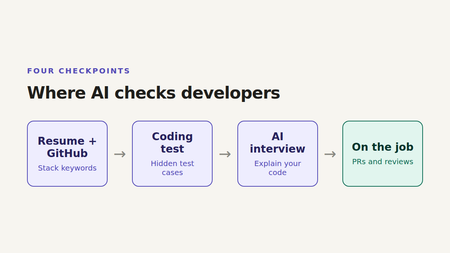
Resume and GitHub. Applicant tracking systems match your resume against the stack in the job post (React, Node, AWS, and so on). Some tools also look at your public GitHub activity.
Coding tests. Online assessments run your solution against hidden test cases, check time and space complexity, and flag copied or AI-generated code.
AI interviews. Some companies now use AI-led technical rounds that ask follow-up questions and score how well you explain your approach and trade-offs.
On the job. Engineering analytics tools track pull requests, cycle time and review turnaround, and AI code reviewers comment on your PRs before a teammate does.
Measures code, not always impact
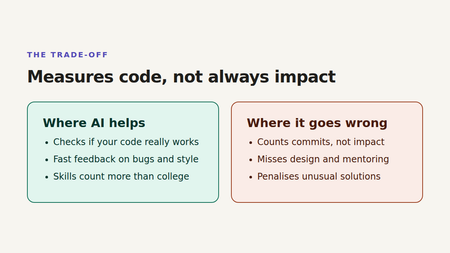
AI is good at checking whether code works, and it gives self-taught developers a fair shot because skills count more than the college on your resume. But it measures what is easy to count. Commits, lines changed and PR counts say little about the developer who spent a week on a hard design problem or unblocked three teammates.
How to work with it
If you're job hunting: list your real stack in the words the job post uses, keep a couple of clean projects on GitHub, and in coding tests handle the edge cases, since hidden tests check exactly those. In AI interviews, talk through your reasoning, not just the final answer.
If you're already on the job: write clear PR descriptions and keep PRs small, and treat AI review comments as a first pass, not a verdict. Make your less visible work (design docs, mentoring, incident fixes) easy to see.
If you lead a team: don't rank developers on commit counts. Use AI metrics to spot bottlenecks, and use people to judge impact.
Final thoughts
AI isn't replacing the people who judge developers. It's changing where that judgement starts. The first filter is now often a machine, and it rewards clear resumes, well-tested code and reasoning you can explain.
The good news is that these are the same habits that make you a better engineer. Write code that works, explain your decisions, and make your impact visible. Do that, and you'll pass both the AI check and the human one that follows.
AI can tell whether your code passes the tests. It still takes a person to see who writes the code everyone else builds on.